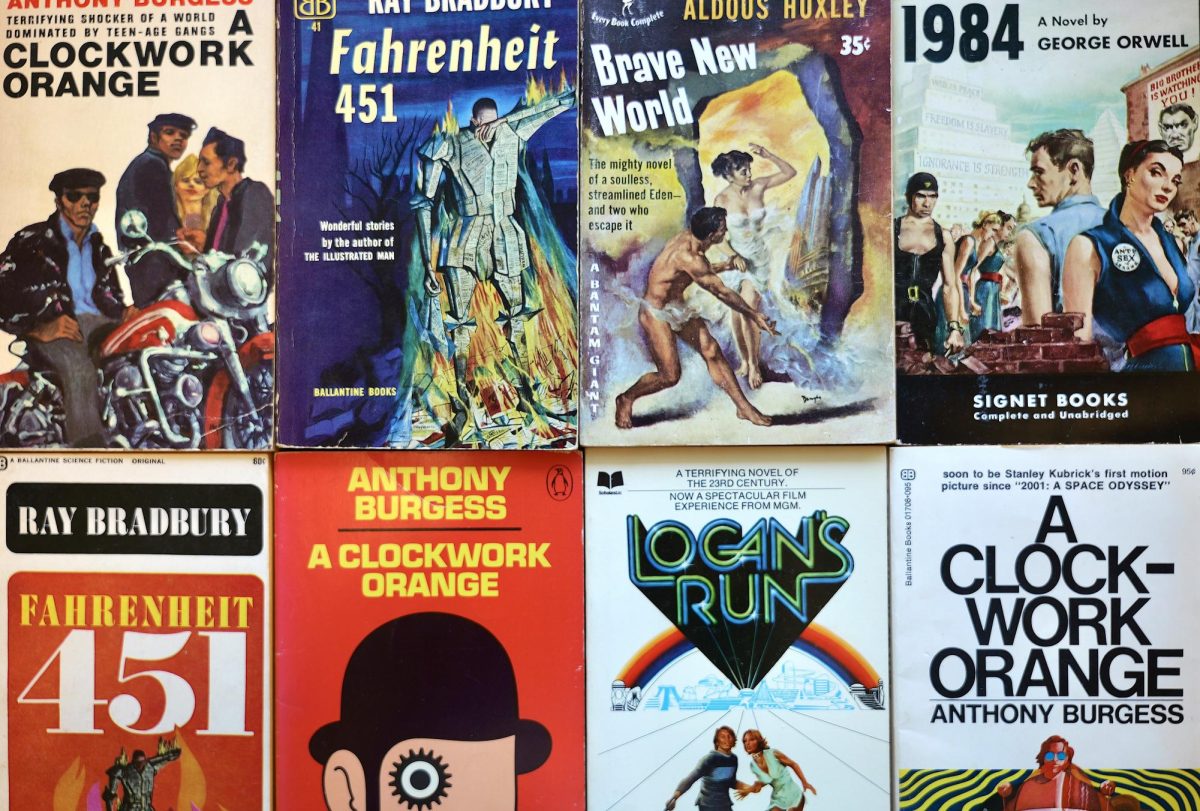
In dystopian fiction, the future often looks uncomfortably familiar.
Don’t be fooled by the extremes: book burnings, monitored conversations, sex as procreational duty, not for pleasure; happiness in the shape of a pill; governments rewriting reality through propaganda and censorship; and entertainment as a mind-numbing opiate.
The dystopian genre, by definition, is a form of speculative fiction that delves into the aftermaths of failed, authoritarian-led societies.
Offred, the protagonist of Margaret Atwood’s 1985 novel The Handmaid’s Tale, is not real, but she symbolizes, in our 2026 present, the uphill struggle of resisting a deep-rooted patriarchal culture. The “newspeak” of George Orwell’s 1949 novel 1984 was invented by the British author, but very much parallels the mindless interactions we encounter every day on social media.
Dystopian literature is intentionally uncomfortable to read as it forces the world’s issues into our sight. The novels are warnings.
Scott Westerfeld’s Uglies (2005) mirrors our image-obsessed society and imagines a future in which everyone looks and acts the same. Octavia Butler’s Parable of the Sower (1993), speculates on environmental degradation, racial prejudice, and wide economic disparity. These novels magnify present-day issues and their future consequences, ultimately educating us to, hopefully, inspire further action.
“Dystopian literature will always be important because it encourages us to explore the idea of extremes,” Josie Vasquez, BOHS librarian, said. “We are allowed to think critically about things like censorship, genetic engineering, surveillance etc., in the safe format of a book.”
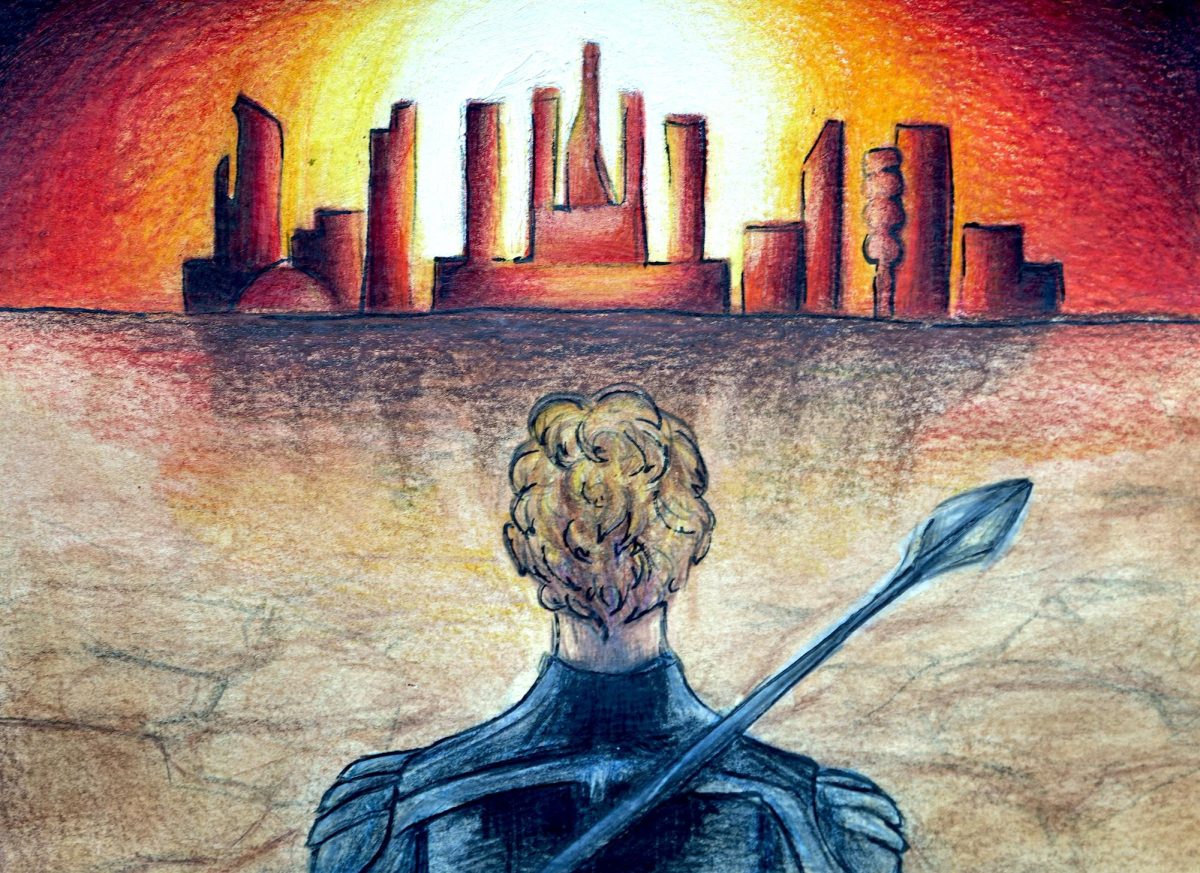
Suzanne Collins’s 2008 novel The Hunger Games depicts 12 districts run by the wealthy Capitol, which forces two teens from each region to fight to the death as a form of mass entertainment, and control. That hypercompetitiveness is reflected in our lives every day where everything is pressure — achieving the best grades; being a team captain; having the most friends.
Another dystopia-themed novel relevant to Gen Z is Veronica Roth’s 2011 Divergent, set in a U.S. where teens are divided into factions — Abnegation, Erudite, Amity, Dauntless, and Candor. Roth explores our constant grapple between conformity and, well, divergence. Ultimately, and thankfully, we don’t all fit into a singular box, a single trait. No one is just brave or just selfless; we are multifaceted human beings. Roth is making a statement about our tendency to conform, but our need to embrace our individuality and uniqueness.
Dystopian fiction is not a 21st century invention. Part of the joy, and horror, of reading older dystopian novels is recognizing themes (and technologies) that remain relevant many decades after the books were published.
Aldous Huxley’s 1932 novel Brave New World depicts a society anesthetized by pleasure, drugged into blissful stupor and made to sacrifice their bodies and minds for the stability of the community. Written amidst the Great Depression, Brave New World warns against extreme nationalism by blurring the line between the individual and the state. Character Lenina Crowne, in an allusion to the Soviet Union’s dictator Vladimir Lenin states, “Everybody belongs to everybody.”
Yet Huxley’s novel, set in Great Britain, centers around a deeper warning around the erosion of individual freedoms. Patriotism is a good thing, like our collective national pride for U.S. athletes in the recent Winter Olympics. But we are also individuals as much as we are a part of a collective. The First Amendment, in fact, protects our right to protest against the government if our liberties have been breached. Huxley’s novel reminds us that individual freedom is not a bonus or a reward for compliance, it is our birthright.
Where Huxley feared that people might surrender their freedom in exchange for comfort, George Orwell imagined an even darker possibility: a world in which freedom is taken by force.
Orwell’s 1949 novel 1984, introduced now-common terms such as “Orwellian,” “newspeak,” “memory hole,” and “Big Brother.” In this bleak vision of the future, the Party controls its citizens through its police-state with constant surveillance and manipulative propaganda. Orwell’s fear of totalitarianism – stemming from the aftermath of Adolf Hitler’s Nazi Germany and Benito Mussolini’s Fascist Italy – is, in part, a nightmare come true.
Aspects of Orwell’s dystopia are recognizable today.
Following the paranoia and chaos after the terrorist attacks on Sept. 11, 2001, the USA Patriot Act expanded government surveillance powers, including phone-tapping, in the name of national security. Ring cameras, introduced in 2013, collect enormous amounts of personal data and can record anyone, almost anywhere, without consent. While not exactly 1984’s “telescreens,” the feeling that Big Brother is always watching us no longer feels entirely fictional.
The ruling “Party” in 1984 also maintains control by directing its citizens’ anger towards an always ambiguous, always shifting enemy — Oceania against Eurasia one day, against Eastasia the next, depending on the Party’s whims. Through fear and division, the Party maintains control.
The xenophobia of Orwell’s fictional world is present today: The latest version of the SAVE America Act will, if passed in Congress, create barriers to voting for many Americans as new documentation of proof of citizenship — a birth certificate or a U.S. passport, for instance, which many eligible voters do not have — will need to be obtained in order to register to vote.
Big Brother, again, is always watching.
Ray Bradbury’s Fahrenheit 451, published in 1953, warns against a society addicted to entertainment and a society where knowledge, in the form of literature, is destroyed. In a technology-based society, the idea that firemen would burn books — to erase history, to stunt literacy — wasn’t such a far-fetched idea due to the scar of the Nazi regime’s book burnings and Bradbury’s fears of a decline in American literacy as more homes acquired television sets.
While the burning of books in Bradbury’s novel is not our present reality, book banning very much is. Conservative groups like Moms for Liberty and No Left Turn in Education frequently attempt to get books banned. According to PEN America, almost 23,000 books have been banned in U.S. schools since 2021.
Fahrenheit 451 also reveals Bradbury’s concerns about the impact technology has on human attention spans. Protagonist and fireman Guy Montag’s wife, Mildred, spends her days absorbed in an artificial television “family” projected across three of the Montag’s living room walls. Her constant consumption of shallow entertainment leaves her numb and detached from both her husband and the world outside her sterile home.
“Part of the joy of teaching Fahrenheit 451 is seeing students making connections between the world Bradbury feared, and the world we live in today,” Alex Koers, English teacher, said. “Robot police dogs, immersive wall-sized TVs, cameras recording everyone, everywhere, the AirPod-like ear thimbles…so much of the technology Bradbury envisioned in 1953 is here with us now, in 2026.”
In 2026, that fear feels relevant again. Rapid advances in artificial intelligence (AI) have exacerbated concerns about job displacement, automation, and declining critical thinking skills. (Readers, ChatGPT is not your friend). A fear of industrialization and machines and humans who think like machines is not a naive fear from the 1950s, it is our present reality.
While much of dystopian literature explores government control, it also often examines social hierarchies; namely, the treatment of women.
Although Atwood claims that The Handmaid’s Tale is not a prediction of the future, the novel does prophesy the plight of women in 2026. Written against the backdrop of feminist movements of the 1980s, the characters in the dystopian Republic of Gilead are restricted to either childbearing or child raising.
Many gender norms have remained unchanged since The Handmaid’s Tale was published in 1985. In recent years, social media has fueled movements like “tradwives,” which promotes rigid and dated gender roles, and misogynist “influencers” like Andrew Tate.
“I think [dystopian literature] really connects to 2026 because as women, we are still trying to advocate for our rights,” Olivia Gaitan (’28), an avid reader of dystopian fiction said. “We have this repressive government that still keeps things out of women’s control, like being president, freedom of movement, inheritance options, and property control.”
When elements of dystopian fiction begin to resemble real life, the genre stops feeling like fantasy and starts functioning as a warning.
In our imperfect world, dystopian literature, thus, remains essential. These novels — from Huxley’s Brave New World to Jacqueline Harpman’s I Who Have Never Known Men, a French novel republished to acclaim in 2022 — shine a light into the shadowed crevices of modern society, exposing the dangers we either ignore, or have been prevented from seeing.
“Dystopian novels force teenagers to question the world around them,” Sophia Penalba (‘28), dystopian literature fan, said.
Beneath the initial excitement of reading the disturbing social scenarios in the pages of dystopian literature is a thought every one of us shares: Hopefully it will never come to that.



Stephanie Matheny • Mar 19, 2026 at 7:05 am
Excellent article, Charlotte! I need to read a few more of these!