
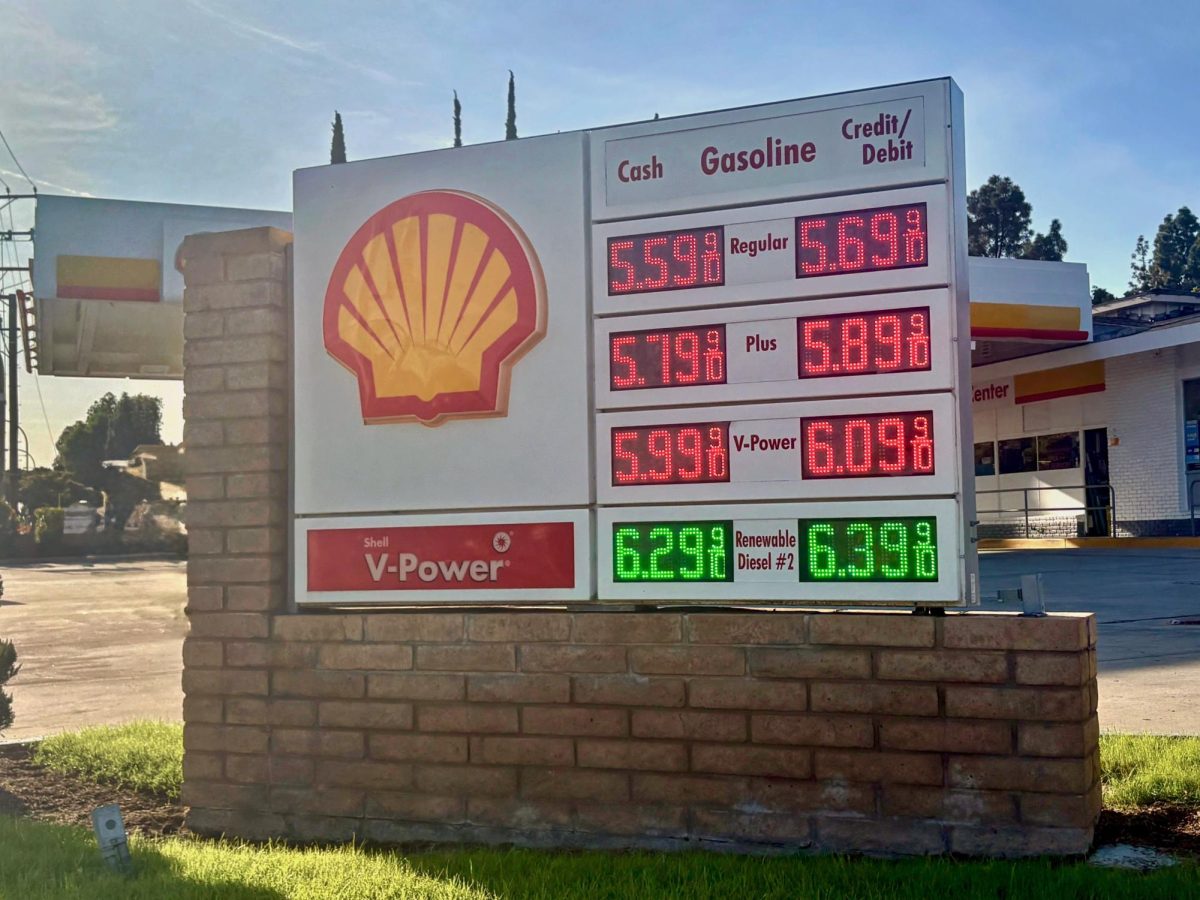
Gas prices across the United States have spiked from global oil supply disruptions, the result of the ongoing military conflict between the U.S. and Iran. In Orange County, prices at the pump average $5.339 per gallon, an 86 cent increase since March.
The rise in the cost of gas is linked to oil tanker traffic in the Strait of Hormuz, the maritime route responsible for the transport of 20% of the world’s oil. Following U.S. and Israeli airstrikes Feb. 28, Iran blocked the flow of oil and resources through the strait in retaliation, lessening supply and thus increasing the average price of oil barrels from $75 to around $100.
Iran’s Islamic Revolutionary Guard Corps (IRGC) warned that any ships attempting to pass through the strait would be “set ablaze” by Iranian forces.
With historical gas prices typically peaking in the spring due to higher demand for driving, prices become especially pronounced in California — the most expensive state for gasoline in the U.S. — where gas consistently exceeds the national average by $1.85 per gallon. Currently, the national average is $3.93 a gallon.
The last time the gas prices saw a similar “aggressive” increase was March 2022 during the beginning of the war between Russia and Ukraine. The global energy crisis from that ongoing conflict caused gas prices to surge from $3.50 to over $5.00 per gallon.
While current gas prices are still $1.12 below the California record average of $6.40 in October 2022, market analysts believe that if U.S. and Israeli airstrikes on Iran’s infrastructure and Iran’s drone attacks continue, California could see averages climb to $6 before summer.
At a Brea Chevron station on East Imperial Highway, regular gas is $5.19 per gallon, with premium options reaching $5.59.
The 76 gas station at the intersection of Imperial Highway and State College Boulevard advertises a regular gallon of gas for $5.59, with premium $5.79.
For BOHS students who drive, the increase in gas has impacted both their finances and routines.
Joshua Kim (‘28) has reconsidered how often he travels by car. “These prices are actually crazy,” Kim said. “Before I go out, I have to stop to think if it’s worth spending all the money on gas first.”
Currently, filling up a standard 12-gallon tank with regular (87 octane) costs $67.08, versus $53.88 from a month ago.
For Farrah Finnie (‘28), who commutes to Irvine for volleyball games at least three times a week, the extra costs are a “burden” to her schedule and finances.
“Having to travel that far every day adds up really quickly,” Finnie said. “Even one fill-up can cost me more than $50, so my parents tell me to fill the tank before prices go up even more.”
Ella Makena (‘26) has been forced to budget more carefully and limit her mileage.
“It sucks because I have to pay for my own gas, and it literally takes up half of my paycheck,” Makena said. To combat the high fuel prices, Makena carpools.
“When I have the time, I take my brother, sister, and even my neighbor places,” Makena said. “If we’re all going somewhere nearby, it just makes sense to go together to save a couple dollars.”
Like Makena, Rylee Szary (‘26), carpools with her water polo teammates to save money on gas. Szary says the team tries to “coordinate rides” to eliminate the burden for every away game and practice. “I have to go from practice to practice carpooling people,” Szary said.
For Jeremiah Ammerman (‘26), the rising cost of gas not only affects his athletic activities, but also how often he socializes with his friends.
“It makes me not want to hang out as much, because it’s so much more expensive to hang out now than before,” Ammerman said. “I try not to drive as far anymore, and it’s just becoming too much for high school students – we’re only 17.”