


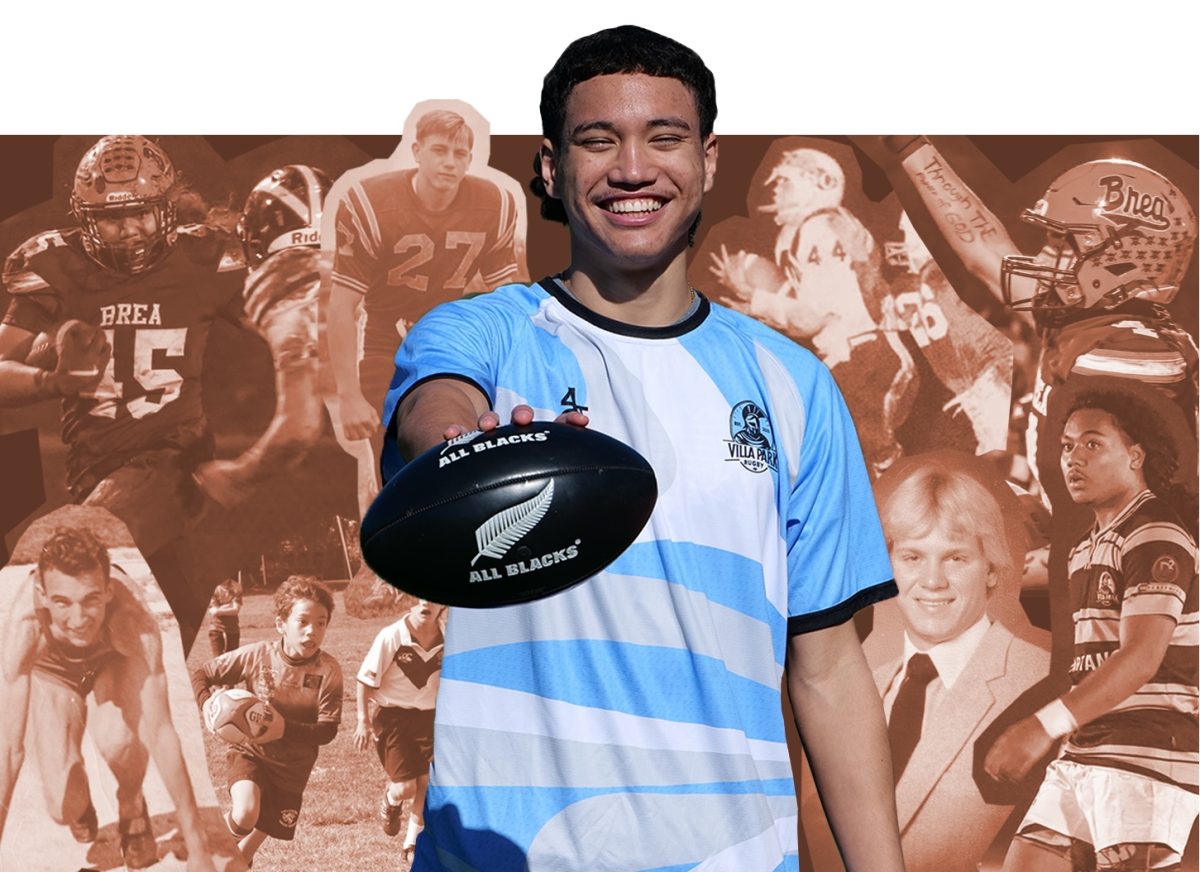
Dalton Tagaloa (‘26) shifts along the backline, scanning for gaps on the pitch as his teammates advance upfield, passing the grass-stained ball backwards and side-to-side. Tagaloa moves with the line, ready to support the attack against his opponents from Edison High School.
Playing on the right wing, Tagaloa, in the powder blue-and-white striped jersey of Villa Park High School, holds his position near the sideline as the ball is recycled from a ruck in the middle of the field. When the pass moves down the line, he steps inward to support the ball carrier, then drifts back outside as the play continues past him. On the next phase, he sprints down the sideline, pulling the defense with him as the Spartans attack the edge.
The game is fast-paced and violent and for Tagaloa, it’s more than a sport he enjoys each winter as a member of Villa Park’s varsity team (BOHS does not offer rugby), it’s a means for him to honor his Samoan heritage.
A niche sport elsewhere in the United States, rugby has a devoted following in Southern California from the region’s large Polynesian communities that have roots in New Zealand, Tonga, Fiji, and Samoa, where rugby is the national pastime.
To the tight-knit Polynesian communities, the rugby fields that dot the Southland often double as spaces where sport, culture, and community intersect.
“Everyone,” Tagaloa said, “knows everyone.”
Tagaloa began playing rugby at the age of six when his family was introduced to the sport during a trip to Australia and New Zealand when his father, Faamanuiaga Tagaloa, met his biological parents for the first time. Although Tagaloa was too young to remember the visit halfway around the world, upon returning to Orange County, his parents encouraged him to join a Fullerton recreational team.
The sport soon became a shared activity that brought multiple generations of extended family together.
Coached by his father, Tagaloa played alongside his cousins, including varsity football teammate Kolo Liti (‘26), turning practices in Fullerton and rec league games in Orange County into family affairs.
Liti quickly became Tagaloa’s favorite practice partner.
“We train together, work out together, and compete with each other all the time because of rugby,” Tagaloa said.
Although this winter marks the cousin’s final season together, 12 years as rugby and football teammates has, according to Tagaloa, “built a bond that nothing can break.”
But it’s the women in Tagaloa’s family that compete at the sport’s highest levels.
Dalton’s sister, Danae Tagaloa, a former member of the Fullerton Lady Lions rugby team even traveled to Thailand for competition. “Playing rugby was one of the best experiences of her life, and it just shows how much rugby is incorporated into our lives,” Danae’s and Dalton’s mother, Dawn Tagaloa, said.
In August 2025, Tagaloa’s cousin, Florinalaula’au “Nalu” Liufau, at just 18-years old, earned a spot on Team USA’s women’s sevens Olympic rugby team. A tri-sport athlete at Walnut High School, Liufau competed in basketball, track, and rugby. Despite playing rugby for only two years, her speed set her apart and earned her an invitation to the USA Women’s Sevens Combine.
“She’s always been super fast,” Dawn said. “It’s insane to watch her zip up and down the field or court.”
Since the cousins live close by, their families would often attend each other’s matches. For Dalton, watching Nalu reach Olympics-level competition has been surreal. “We were going to her club games, and next thing you know she’s on Team USA,” Dalton said.
Such a notable family history in sports has compelled Dalton to raise his own expectations. Tagaloa said he’s “always wanted to make [his family] proud on the field because they’re so good.”
While rugby links Tagaloa to his father’s Samoan heritage, football ties him to his mother’s side of the family.

A four generation BOHS football legacy began with Dalton’s great-grandfather, Glen Connelly (‘41), a BOHS standout who lettered in football and track and placed third in the 50-meter dash at the Southern California Meet at the Los Angeles Memorial Coliseum in 1941.
After graduating from the Birch Street campus, Connelly joined the Navy’s Seabees, which was, at the dawn of the United States’ involvement in World War II, one of the largest construction forces in U.S. military history. Over 325,000 men served in the Seabees, building airstrips, bases, roads, and other infrastructure throughout the Pacific Islands and Europe.
Even while constructing airstrips in the Pacific Theater, Connelly’s athleticism stood out. According to his granddaughter, Dawn, during work breaks, he would line up with his fellow sailors and race down a flat stretch of tarmac, consistently finishing first. “He would always win,” Dawn said.
While in the service, Connelly picked up photography in the 1970s as a hobby and returned to his hometown and to BOHS’s stadium sidelines to document the varsity football team’s games through the lens of his Kodak.
A moment that cemented Connelly’s name in Wildcat football lore occurred while he was photographing a game’s action and a play spilled across the sideline, toppling Connelly, and breaking his tailbone. Despite the injury, he was back on the field the next week. “He would not miss a game,” Dawn said of her grandfather.
“He was a legend after taking that hit,” Nate Stewart (‘90), a member of the team Connelly was photographing and the current president of the Wildcat football booster club, said.
In the ensuing years, Connelly received multiple appreciation awards from the Wildcat football program and was honored with a temporary exhibit at the Brea Museum and Historical Society.
The sporting legacy of the Tagaloa family also includes Dalton’s grandfather, John Hutcherson (‘68), and later his great-uncle, Greg Hutcherson (‘85), both of whom also donned the green and gold Wildcat football jersey.
The younger Hutcherson, Greg, served as captain during his junior and senior seasons in ‘84 and ‘85.
Dawn remembers her uncle as much more than an athlete. “He was the kindest soul, and he would give the shirt off his back to anyone,” Dawn said.
Greg passed away from bone cancer shortly after graduating, but his impact on the program endures. In his honor, the Wildcat football team established the Greg Hutcherson Award, a scholarship presented annually to a senior player who demonstrates strong character. (This year’s winner was senior linebacker Jake Bryant.)
“I cry every time they give out the award,” Dawn admitted.
Dalton honored his great-uncle by wearing the number four during his varsity football career.
It’s both that long local history in football excellence and his family’s current successes that motivate Dalton.
Another family member who is competing at their sport’s highest level is cousin Puka Nacua, First Team All-Pro wide receiver for the NFL’s Los Angeles Rams. (Last weekend, Nacua led his team to the NFC championship game with 56 yards receiving against the Chicago Bears.)
“Having a super athletic family pushes me to be better,” Dalton said.
This past fall, Dalton and Liti both played key roles on BOHS’s varsity football team, which advanced to the California Interscholastic Federation (CIF) Southern Section Division 8 championship game.
Dalton played free safety, recording five interceptions and 47 tackles this past season, earning All-Star honors in the North vs. South game.
Liti led the Wildcats’ offense at running back, rushing for 1,032 yards and 15 touchdowns while earning All-CIF and Kappa League First Team All-League honors.
But sometimes, the most influential people in Dalton’s athletic journey aren’t the ones sharing the field with him, but the ones in the stands.
This season carried particular emotional weight for Dalton. In August, his grandfather, Tom Jennings, passed away, making this past season the first time he’d played without seeing his grandfather in the Wildcat Stadium stands. Dalton, however, found a way to keep his grandfather close on game nights.
“I had my grandpa’s name, and the year he was born, written on my arm,” Tagaloa said. “It meant a lot to my grandma, and I know she was always happy to see it. I feel like he’d be proud of me.”
His grandmother also keeps her late husband close during games, honoring him from the stands. Dawn Tagaloa said, “She has my stepdad’s ashes on her necklace so every time Dalton has an interception she’s always like ‘Ahh, Tommy did it’.”
At times, Dalton doesn’t just feel his family’s support, he hears it. Dawn’s voice carries all the way to the field. “She’s most definitely the loudest one in the stadium,” Dalton laughed.
Ultimately, Dalton’s family, culture, and faith, has shaped him to be the athlete and person he is today.
In the Samoan language, aiga means “family,” but the term means much more to the Samoan community: Aiga represents a deep sense of responsibility, respect, and togetherness.
And nowhere is the Tagaloa family’s togetherness more evident than on Friday nights, when as many as 35 family members and friends gather in Wildcat Stadium to watch Dalton and Liti. The large turnout reflects not just a six-decade legacy of school spirit, but a shared commitment to showing up for one another.
It’s typical for many families to only get together during the holidays, but the Tagaloas meet with their families more frequently, whether a meal or casual get-together, time spent together is treated as a priority, a celebration, rather than an obligation.
“Our families are really close, which is just a part of our culture,” Dalton said.
The Tagaloas even renovated the backyard of their Brea home to accommodate the large family functions.
“We have a good size backyard, but every seat is filled when we have family over,” Dawn said. “There’s just so much family on Dalton’s dad’s side.”
For Dalton, his Samoan heritage is something he’s grown up practicing, not just learning about.
One of Samoa’s most significant traditional practices is tattooing. Tagaloa’s uncle, Si‘i Liufau, is a renowned tattoo artist in Garden Grove and a “guardian” of the Samoan art of tatau, a traditional method of tattooing involving hand tools and intricate patterns.
Each tattoo tells a story, with every line and pattern carrying meaning passed down through generations. In Samoa, receiving a traditional tattoo is considered a rite of passage. Men receive the pe‘a, while women get the malu, marking maturity, service, and cultural responsibility.
Dalton’s family members, cousin Nalu, cousin Tiala, (a BOHS record-holder in softball), and mother, Dawn, carry these symbols. Dawn’s stingray tattoo, for instance, symbolizes protection, guidance, strength, and adaptability, and was even featured in Disney’s animated movie, Moana. (Dawn jokes, “I got the tattoo before Moana came out. I had it first.”)
The 2016 film connects to the family in another meaningful way: Samoan pride — and dance — pulses through Nonosina Polynesian Dance Company, directed by Tagaloa’s aunt, Tiana Liufau. Tiana served as the choreographer, motion curator, and cultural consultant for the Moana films.
Although some of his family members represent their Samoan heritage through tattoos and dance, Dalton found his connection, his aiga, on the rugby and football fields. When Dalton steps onto the field, he wears more than a jersey number, he carries the legacy of generations.
“Every game, I’m just trying to represent my family and the people who’ve been behind me since day one,” Tagaola said.
Photo Illustration by Wildcat Opinion Editor Quyen Anderson.
Collage Photographs (clockwise from top left):
Dalton’s cousin, Kolo Liti (‘26), during a 2026 varsity football game. (Issabella Garcia)
Dalton’s grandfather, John Hutcherson (‘68), in a 1967 Gusher yearbook photo. (Courtesy of Dawn Tagaloa)
Dalton Tagaloa, photographed by Issabella Garcia in Wildcat Stadium.
Greg Hutcherson (‘85), Dalton’s uncle, makes a catch during a varsity football game. (Courtesy of Dawn Tagaloa)
Dalton points skyward after an interception during a Nov. 21 CIF playoff game against Irvine High School. (Issabella Garcia)
Liti at a Villa Park High School rugby game. (Issabella Garcia)
Greg Hutcherson (‘85) in a 1985 Gusher yearbook photo. (Courtesy of Dawn Tagaloa)
A young Dalton competing at a Fullerton youth rugby game. (Courtesy of Dawn Tagaloa)
Glen Connelly (‘41), Dalton’s great-grandfather, at the L.A. Memorial Coliseum. (Courtesy of Dawn Tagaloa)


Jerry • Jan 25, 2026 at 8:13 am
Wow! Quite the article, nice work.