


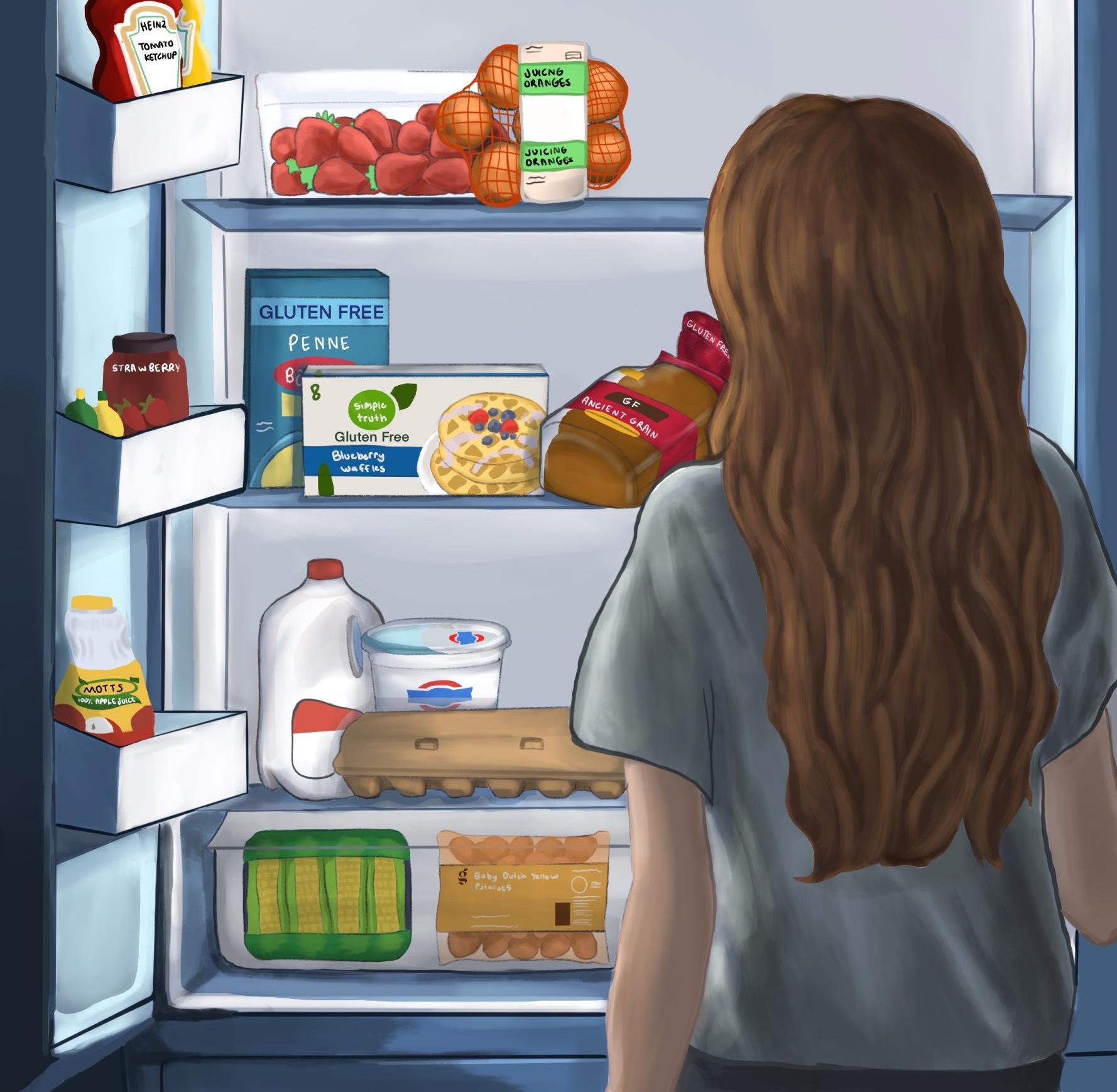
It wasn’t like I was dying, but it felt like something inside me was. In a matter of months, I was seeing everything in “lasts” — my last churro, my last trip to my favorite restaurant, my last cake creation. I was saying goodbye to more than food – I was saying goodbye to a part of myself.
Growing up, I was the family chef and baker. In my free time, I scoured the internet for new recipes, hosted baking competitions with neighborhood kids, and bonded with my Nona while preparing Thanksgiving sides and Christmas cookies. I received cooking kits from around the world — Ethiopian spices, Thai curries, and Italian doughs — to create unique dinners for my family. And whenever someone was in the kitchen, I was there too: chopping, stirring, and assisting in any way I could.
When I was 12-years old, my mom scheduled a series of blood tests for our family “just to be safe.” I didn’t think much of it. I didn’t have symptoms of anything, so there was no reason to worry.
As I sat in the lab chair and watched the nurse stick a needle into my arm, switching out vial after vial, my blood filling each one, something in my stomach turned. So many vials. So many different tests. Iron. Peanut. Dairy. Gluten. But all I felt in that moment was the sting of the needle pulled from my bruised vein, a pain that foreshadowed my future.
Soon after, the test results arrived. Official confirmation would come later, but for now, the message was clear: something was wrong. Despite my mom’s best efforts to ease my fears and concerns, I was terrified, and I sat in my room that day and cried.
If true, a diagnosis of celiac disease, an autoimmune disease where the body’s immune system attacks the small intestine when in contact with any form of gluten, a protein found in wheat, barley, and rye, would be life-altering. Celiac disease is more than just sacrificing treats like cookies and everyday staples like bread, but also common condiments like soy sauce, packets of seasoning, popular candies, and even toothpaste.
In addition to drastically altering my relationship with food, the disease impacted my life experiences. That summer, my family had trips planned for Europe, Palm Springs (an annual tradition), Disneyland, and summer camps. With the diagnosis, however, those plans felt tainted, even dangerous. The thought of traveling through Europe without buttery croissants, English biscuits, and sweet macarons made me feel like I was already losing the adventure before it even began.
But luckily, the doctors said that it was vital that I continue to eat normally for the time being because of the upcoming procedure. To ensure an accurate diagnosis for the endoscopy, continuing to eat gluten is crucial to reveal all the intestinal damage that had been done for the last 12 years of my life.
However, the anticipation of change was a looming cloud over every meal, reminding me that things would not ever be the same.
The day of the endoscopy, a procedure that looks inside the small intestine, arrived.
My stomach growled with hunger as I hadn’t eaten for almost 24 hours. The last thing I remember before the anesthesia seeped in were the beeps of the monitor beside my bed and the doctor in powder blue scrubs and a surgical mask walking around me. Then, darkness.
I woke up confused and alone and in pain from the procedure. I looked around the sterile room for my parents.
Finally, my mom and dad emerged from behind the curtain in front of my bed, trailed by the doctor. She spoke quietly to my parents, as if sharing a secret. The doctor turned to me and said “goodbye” and with a soft smile walked out of the room.
I noticed that my parents’ faces had changed from concerned to sweet. My mom looked at me and said, quietly: “The endoscopy confirmed it: celiac disease.”
It was not like I was expecting a different result, but now it was a reality, it was verified. I was now undoubtedly part of the three million people who had to scour menus to evade inflammatory foods, to avoid gluten.
With a single surgical procedure, my life — my food, my baking, my normalcy — had changed forever.
Immediately, my family and I rid the house of gluten and bought new food preparation supplies like pans, air fryers, and silverware, because even traces of gluten would trigger symptoms. A safe gluten free diet means less than 10 milligrams of gluten per day, the equivalent of a single pinch of wheat flour.
But more challenging than restocking the pantry and replacing cutlery was learning how to explain to others this invisible thing that now ruled my life. I went from being an “easy eater” — eating everything at parties, my friend’s lunches at school, the treats for in-class rewards, the donuts at church — to politely declining, to constantly checking and questioning, and sometimes pretending not to be hungry at all.
I learned detective-level label-reading to communicate to family and friends which foods I could actually eat and which I actually liked.
Often, I have to settle for a simple salad while my friends dig into breadsticks or burgers and fries. No longer the “easy eater,” I can feel singled out, even left out.
It’s an easy fix, the GI doctor explained, just eliminate gluten completely.
Easier said than done.
The challenge with celiac, as opposed to having a gluten intolerance, is that people with celiac cannot ingest even a crumb of gluten. Those of us with the disease can be symptomatic (stomach aches, rashes, vomiting, anemia, or bedridden for days), or asymptomatic (no immediate external reaction); but what we all have in common is our insides being destroyed, and without eliminating gluten, we can eventually get intestinal cancer. Around the world, about 1% of people have celiac, but only 30% of those Americans will be diagnosed in their lifetime.
Once, at a newcomers’ social for school, a girl asked why I wasn’t eating the provided ice cream.
“I have celiac disease and can’t eat ice cream,” I replied.
She nodded and suggested that I should just eat the ice cream from inside and not eat the cone. I smiled politely at her cleverness. But, that isn’t my life.
…
I still think about those “lasts” sometimes, but now they feel less like “goodbyes” and more like moments that are making me who I am.
I learned about resilience, how to adapt when things don’t go as planned, and I’ve begun to advocate for myself and others.
I can’t eat everything I used to. I can’t just enjoy the In-N-Out drive-thru on weekends with my friends.
But it’s also opened my eyes to how others might be hurting, and how I can look out for them.
I’ve been the recipient of so much kindness and generosity.
This journey has instilled in me patience and confidence and the courage to speak up, for myself and for others.



Jaime • Jan 27, 2026 at 4:49 pm
Thank you for sharing your experience with us, Ev. Your resilience and grace throughout your diagnosis journey to find your new normal is admirable. JR
Priscilla Cruz • Jan 26, 2026 at 8:53 am
Thank you Ev for your vulnerability and willingness to share on how this huge life change has affected you and your family. Your eloquence in your words have helped me to understand this disease more than ever. Super proud of you!!
Jeanmarie Beard • Jan 26, 2026 at 8:03 am
I’m better informed and less judgmental because of your well written article. I knew very little about this disease, prior to reading this. I’ve learned so much and am much more sensitive to the struggles of those with celiac. Thank you for sharing!
Jacquelyn • Jan 26, 2026 at 7:32 am
Beautiful, Ev ❤️
Stephanie Matheny • Jan 26, 2026 at 7:29 am
I imagine this was vulnerable to write about, and I really appreciated the first person perspective of a diagnosis/experience like this. I’m also very proud of how you’ve handled and adapted to such a big and disappointing change.
Samantha Barrett • Jan 25, 2026 at 11:48 pm
Thank you for sharing your journey with us Ev. So informative and helpful while remaining very personal. Appreciate you!
Claudia Christensen • Jan 25, 2026 at 9:06 pm
Evelyn, I have to admit I did not know any of this. Thank you for opening your heart to share your experience with me and with so many who are suffering in silence. Your ability to express your feelings is uncommon, yet helpful. The way you explained the facts will change lives and give hope to others. Thank you. Claudia
Cynthia Hambelton • Jan 25, 2026 at 8:23 pm
Beautifully written. Your honesty and vulnerability really shine through, and I learned a lot from your perspective. Thank you for sharing your story, Ev.
Beth Hambelton • Jan 25, 2026 at 6:40 pm
I am grateful for Evelyn’s willingness to share her disease and experience with us. I’ve not really understood just how damaging gluten is for those who have celiacs. Well written and eye opening article by a courageous young woman. Very proud of her.
Cory Nguyen • Jan 25, 2026 at 6:22 pm
Thank you for sharing this, Ev. I loved reading your side of this experience. I think your story will help a lot of people. So well written! Brave doesn’t begin to describe it! Bravo!
Anna Choi • Jan 25, 2026 at 6:11 pm
Wow! I’m so impressed with how Evelyn’s words captured my heart and attention about her experience with celiac disease. Thanks for sharing. ❤️
Amanda Sims • Jan 25, 2026 at 6:08 pm
Way to be brave Ev. Very well written. Proud of you!!!