

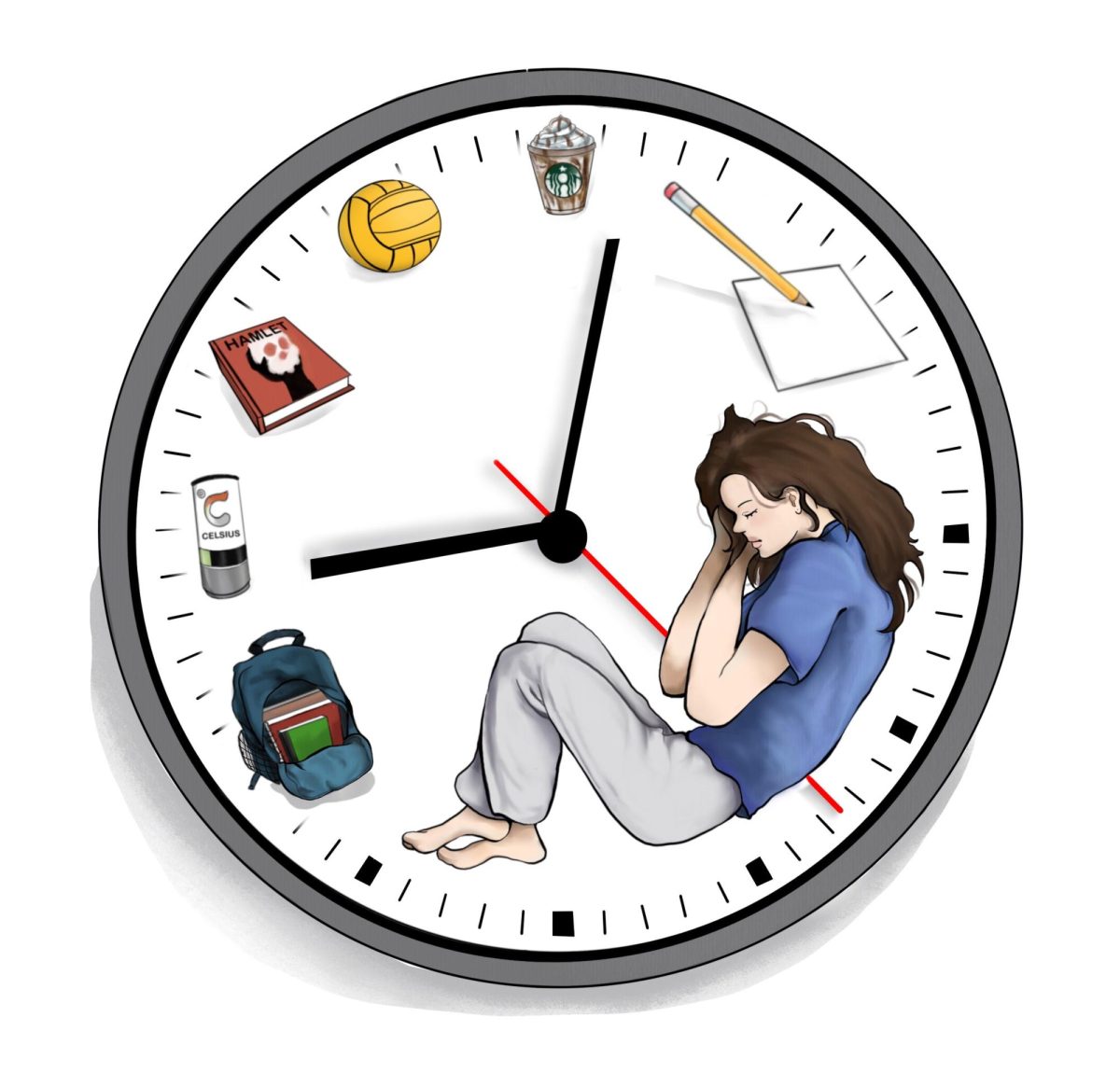
A Google Doc sits in front of me, blank. It’s 11 p.m. and I have just begun my first homework assignment. I am exhausted after a full day of water polo practice, club meetings, and volunteering, but my already-suffering GPA reminds me that sleep is not an option.
At 1 a.m. my writing gets sloppy and my eyes strain to see the words on my chemistry worksheets and AP Euro notes.
By 3 a.m. I get a case of the “long-blinks” which turns into an “I’ll do it later” and I finally give in to sleep after a 21-hour day.
Startled awake by an alarm (okay, five alarms), a new day begins.
I force myself out of bed, get ready in record time, and scurry out of the door sporting eye bags, bedhead, a concoction of caffeine and sugar (but mostly caffeine), and the grumpiness of someone who slept for three hours.
As I shuffle into my 7:30 a.m. class, it’s obvious I’m not alone in this daily battle for sleep; the room is filled with exhausted and lethargic students who are similarly overwhelmed by sports, clubs, and academics (or binging Netflix or playing Roblox late into the night).
We’re victims of a vicious cycle of marathon awakeness and unsustainable routines that impact a majority of American teens. In fact, over 70% of high school students don’t regularly get the recommended amount of sleep of eight to ten hours.
Between academic classes and electives between 7:30 a.m. and 3 p.m.; after-school activities like sports and performing arts into the late afternoon; time with family at dinner; hours of homework afterwards; and feeding our social media addictions past midnight, U.S. students average around six to seven hours of sleep on school nights, a number that continues to decline.
The effects of sleep deprivation go beyond short-term dozing off and brain fog. Chronic sleep deprivation is linked to increased risk of depression, anxiety, and mood swings. Many of these unpleasant characteristics are often ascribed to “being a teenager,” but the real culprit is sleep deprivation.
Insufficient sleep can result in a weakened immune system, obesity, hypertension, and other cardiovascular diseases.
The lack of sleep doesn’t just sabotage our health, however; it also steals our potential. An assignment that should only take 30 minutes to complete somehow morphs into a two-hour ordeal when we’re nodding off between questions or fighting a thousand-yard stare. Our brains become foggy, our creativity dulls, and simple decisions feel impossible. Because of chronic lack of sleep, we’re rarely at our best.
Why do we do this? Why do we fight sleep when know it’s actually good for us? For many teens (including this one), the notion of getting adequate sleep on a school night seems impossible, a fantasy.
Despite our bodies begging us to rest, “hustle culture” and toxic productivity buzzes through our phones, romanticizing “the grind”; a harmful reminder that encourages students to put their body’s needs aside in exchange for slightly higher grades.
Sometimes, it feels like a competition for who can go to bed the latest. (Or not at all. Two of my classmates last year had running tallies of their all-nighters.)
But wearing ourselves out isn’t admirable, it’s harmful, to both our bodies and brains. No one should have to choose between rest and success; yet, that’s the impossible decision we face daily.
We could keep pretending we’re invincible, fueled by venti lattés and Celsius energy drinks, or we could acknowledge the truth: rest is essential if we hope to achieve our goals.
But how?
Setting boundaries with our time is a good place to start. Watch one episode, not three, of the new season of Stranger Things, which will still be available to stream after the Spanish homework is finished.
Do less. On the surface, that sounds contradictory to our missions of being high-achievers, but in actuality, colleges want standout students, not students who are stretched too thin. Be realistic when choosing what courses to take and clubs to enjoy — four APs instead of five, two clubs, not five. No one, after all, is receiving accolades at Senior Awards Night for being the busiest, most exhausted student.
Doomscrolling through TikTok into the early morning hours, sending Instagram reels to friends at 2 a.m., or playing Valorant until our eyes burn are also major contributing factors in the battle teens face in their quest for sleep. Fun fact: Teens who put their phones down gain an extra 21 minutes of sleep each night, which adds up to an extra hour and 45 minutes of sleep in a school week.
Shutdown the MacBook, set aside the phone, close the textbook. Because choosing to sleep is choosing ourselves — our health, happiness, and success. Exhaustion isn’t a personality trait, and sleeplessness isn’t proof of our ambition.





Beth Hambelton • Dec 6, 2025 at 3:13 pm
Excellent opinion piece, filled with truth that our culture needs to heed.