


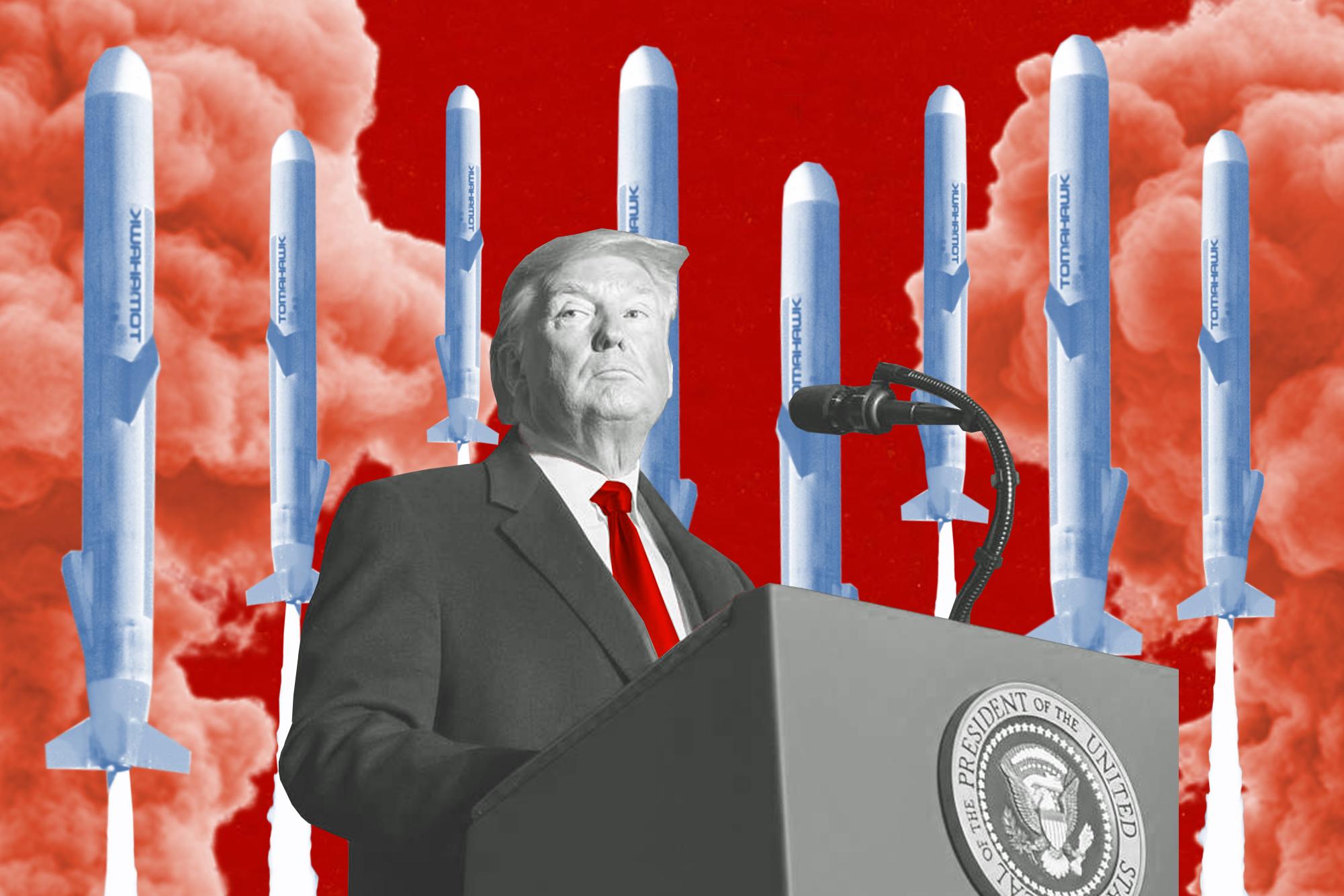
On April 5, Easter morning, Americans woke up to a message from President Donald Trump threatening the destruction of Iran: “Open the F—in’ Strait, you crazy b—ds, or you’ll be living in Hell – JUST WATCH! Praise be to Allah.”
Two days later, Trump escalated the threats: “A whole civilization will die tonight, never to be brought back again. I don’t want that to happen, but it probably will…”
When Trump campaigned for his second term for president in 2024, he explicitly promised that he was going to put “America first” and prevent the U.S. from engaging in foreign wars. “I’m not going to start a war. I’m going to stop all wars,” he boasted in his Nov. 6, 2024 victory speech.
Fifteen months later, however, his orders for the ruin of Iran reveal that the “America first” promises he made during his third campaign for president were meant to generate votes, not to actually benefit Americans.

On Feb. 28, 2026, the U.S. bombed Iran, initiating Operation Epic Fury. The objective of the attack is still unclear — the Trump administration has offered shifting explanations, including military degradation, regime change, and countering nuclear threats. In a reasonable world, the violent attack of another country would have a clear purpose, but there is nothing reasonable about Operation Epic Fury (even the name conveys violence and war).
The conflict comes after failed attempts to end the war between Russia and Ukraine; the U.S.’s involvement in the war between Israel and Palestine, whereby the U.S. gave $17.9 billion in security assistance to Israel; the bombing of Iran’s nuclear sites in 2025; and the covert extraction and detaining of Venezuelan President Nicolás Maduro in January.
What happened to putting America first?
Since the first strike on Iran, over 3,000 people have died, including 1,701 Iranian civilians and 13 U.S. service members. On Feb. 28, 160 Iranians, mostly students, were killed in a missile attack.
For what, exactly, did they die?
Iranian Supreme Leader Ayatollah Ali Khamenei ruled Iran from 1989 until his death by airstrike on Feb. 28. Khamenei was an authoritarian who murdered his own people — in response to protests from Iranians in Dec. 2025, he had upwards of 7,000 of his own citizens killed. Over his 36-year rule, human rights organizations like Amnesty International reported that Khamenei tortured tens of thousands of Iranians, conducted unfair trials, forced confessions, repressed women, and controlled the media.
Does Khamenei’s violent dictatorship give the U.S. the right to unilaterally attack another country? (As of April 16, Congress still hadn’t issued an Authorization for Use of Military Force).
Behind every airstrike and political justification are the innocent civilians caught in the crossfire.
For someone who deemed war a line he wasn’t willing to cross — Trump claimed he deserved the Nobel Peace Prize because he had stopped “8 Wars PLUS” — Trump appears comfortable talking about “annihilating” Iran’s forces, even if it means the deaths of innocents. Of the many still-ambiguous goals of the bombings, the Iranian military is certainly being degraded, but at too high a cost.
If the president and the Department of War (an ironic change in name for the supposed anti-war president) under Pete Hegseth, focused more on diplomacy and less on flexes of military strength for posting on the White House’s social media accounts, destruction could have been avoided.
The consequences of Trump’s and Hegseth’s military confrontation are currently being felt worldwide due to Iran’s promise to set any ships that pass through the Strait of Hormuz “ablaze.” In response to the bombing, Iran took control of the Strait, passage for 20 percent of global oil production, and gas prices worldwide have subsequently risen. In Brea, gas now costs over six dollars per gallon.
As of April 13, the United States blockaded the Strait of Hormuz without the backing of NATO who thinks the Strait should be opened through diplomacy. This has cost the Iranian government an estimated $270 billion so far.
By April 18, Iran again blocked the Strait and Revolutionary Guard gunboats opened fired on a tanker.
Clearly, Iran has yet to be “decimated,” and Trump’s administration is scrambling to gain footing in this war of choice.
Public policy budgeting experts project that the conflict is costing the U.S. two billion dollars every day and is estimated to cost one trillion dollars overall.
With each passing day, the consequences for Americans grow.
It’s time that Trump’s bravado is put to an end and his promises of peace put to the test. The question is no longer whether this war can be justified – because when the most powerful man in the nation warns that “a whole civilization will die tonight,” the world should not have to guess at whether he means it.
This conflict exposes the dangers of unchecked presidential power (regardless of which party has control) and empty campaign promises. “America First” was never a policy, but a slogan, and that slogan is being measured in human lives and Americans’ hard-earned money.
Photoillustration by Quyen Anderson (’28) from images “President Donald Trump speaks during an event at Joint Base Andrews” by Spencer Slocum, and “Air-To-Air Right Side View of a Tomahawk” by Bob Struth, under the CC BY-NC 4.0 license.









Anonymous • Apr 22, 2026 at 4:00 pm
Well said.
Cory • Apr 21, 2026 at 7:38 am
Incredibly well written. I’m glad to see high school students so well informed about what is going on in the world around us. Good for you for taking this on!
Jaime Robertson • Apr 21, 2026 at 6:05 am
This was a well informed and brave article.
Thank you for addressing a topic that many Americans are conflicted about.
Beth Hambelton • Apr 19, 2026 at 1:30 pm
Charlotte, your courageous opinion article has put into print some of my own thoughts. Thank you for taking this brave step in exercising your 1st amendment rights. I am so proud of you.