


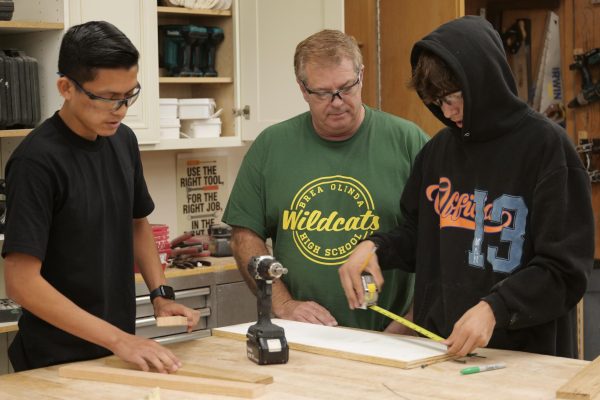
A cacophony of power tools and student voices fills the BOHS shop, and at the center of this very controlled chaos stands Patrick Axtell, one hand steadying a two-by-four, the other gesturing for a student to attempt drilling a hole again. He observes and listens, calm amongst the whir of drills and the pounding of hammers.
This is the world of construction education at BOHS – specifically, the Career and Technical Education (CTE) pathway known as Building Industry Technology Academy (BITA) – a place where students learn by doing, where precision matters as much as patience. It is a world in which Axtell mentors his students daily. But despite the expertise and experience, teaching construction was not Axtell’s initial plan.
Before Axtell taught students how to frame a wall, measure a span, and set a foundation, he led students in a far different environment: church basements during Bible studies driven by conversations over questions of faith, personal struggles, and spiritual formation.
Axtell’s first career calling was Christian leadership. “I wanted to become a youth pastor, to make an impact on kid’s lives, teenagers, young adults,” Axtell said.
Axtell graduated from Vanguard University in Costa Mesa with a Bachelor of Arts in Pastoral Ministries and a Master of Arts in Biblical Studies. Upon graduating, Axtell began work as a pastor. He felt called to the ministry during long afternoons at church, sitting beside teenagers who were trying to navigate friendships, doubts, and faith. Axtell hoped to “make an impact” on teenagers and young adults in his new career.
Those first years in the ministry taught him how to guide people, and helped him understand how to meet individuals wherever they were; skills that would later become essential in a high school classroom.
Even while immersed in theological study, Axtell kept honing his skills in building and construction. During his senior year of high school in Apple Valley, he met his mentor, Ron Tasseo, who owned a cabinet shop in the high desert community. After moving to Costa Mesa for college to pursue a pastoral ministry, Axtell would still make the 97-mile trek to San Bernardino County every weekend to continue learning cabinetry.
It was in that shop – surrounded by sawdust, tools, and the smell of freshly cut wood — Axtell discovered not just a trade, but a devotion for woodworking. As a young mentee, he was fascinated by the precision of the industrial craft and the satisfaction of turning raw materials into something functional and beautiful.
Years later, Axtell found himself quietly drifting out of step with the church he served. It wasn’t one meeting or one disagreement that pushed him away, but a slow accumulation of movements – committee discussions that left him uneasy, and program decisions that didn’t reflect the kind of relation, hands-on ministry he felt called to.
“A couple of the churches went in a different direction than I was going to,” Axtell said.
Instead, Axtell chose to focus on his other passion: mentoring students in a workshop setting, where guidance comes through problem-solving, rather than sermons. Although he still helps out at church, it is no longer the center of his career the way it once was.
The combined experience of leading others and construction compelled Axtell to launch his own company, the Costa Mesa-based Axtell’s Custom Building.
“I actually taught all of my employees the trade,” Axtell said.
Just as his mentor in Apple Valley, Ron Tasseo, had invested in him, Axtell wanted to provide his employees, and later, his students, the same opportunities he had been provided.
While his business remodeling homes was flourishing, Axtell discovered that the North Orange County Regional Occupation Program (NOCROP) was looking for teachers. “There was an opportunity,” Axtell said. “I interviewed with them and had enough experience, and they allowed me to teach.”
The work would involve leading hands-on construction courses to both high school students and adults, the same skills his mentor had once taught him.
In 2015, Axtell was hired at BOHS to lead its BITA program.
Axtell teaches the craft as it is practiced: through hands-on engagement, teamwork, problem-solving, and patience (qualities developed during his years leading a ministry team). His classroom — which hosts four levels of the program, from BITA 1 to BITA 4 — is a busy workshop, with students collaborating to build tangible projects, like building a shed from the ground up, framing a house, and installing plumbing systems. The four-year BITA pathway is designed so that “even if [students] do not become contractors, they learn how to use tools, how to build stuff, and how to fix stuff at their house,” Axtell said.
Jasleen Mann (‘26), BITA 4 student and co-president of BITA Builders club, has benefitted from the practical skills Axtell has taught her. “I’ve been able to fix so many broken things in my home because of what I have learned,” Mann said. “I know it’ll help me in the future, too.”
BITA 2 student James Vo (‘29) describes Axtell as approachable and supportive, someone who trusts his students to learn by doing, and to be independent. “He’s a really great guy,” Vo said. “He lets us work on our own projects.”
Axtell pushes all his students to see themselves in the trades, especially young women who may not, initially, envision a place for themselves in construction. (The advanced BITA 4 class is, according to Addison Criner (‘26), BITA 4 student, evenly split between girls and boys, but the program, overall, is “mostly guys” according to Axtell.)
Over the years, a number of his students have earned their contractor’s license, while others have gone on to become electricians and plumbers.
The students who choose not to pursue construction as a career — like Criner, who aspires to work in the medical field — walk away with skills that will stay with them for life, skills they’ll use in their own homes and families.
Criner, who also serves as co-president of BITA Builders, joined the class by accident.
“I didn’t really know much about the program yet,” Criner said, “but I’d always liked working with my hands…and I kind of fell in love with it.”
Criner stayed in BITA all four years because of the skills she gained and because of Axtell.
“What motivated me the most was probably my teacher,” Criner said. “I can tell you much I’ve developed: I know how to do electrical, I know how to fix drywall; skills I can use in my day-to-day life even if I don’t pursue a BITA career.” (“She knows how to build a house,” Axtell said of Criner.)
Axtell often thinks back to his mentor, the builder in Apple Valley who first took him under his wing. He believes the greatest gift he can give his students is the chance to discover what they are capable of and gain skills that they can support themselves with in the future. Whether they pursue construction, simply want to work with their hands, or hope to be more capable home owners, the skills they learn will serve them throughout life, as they did for him.