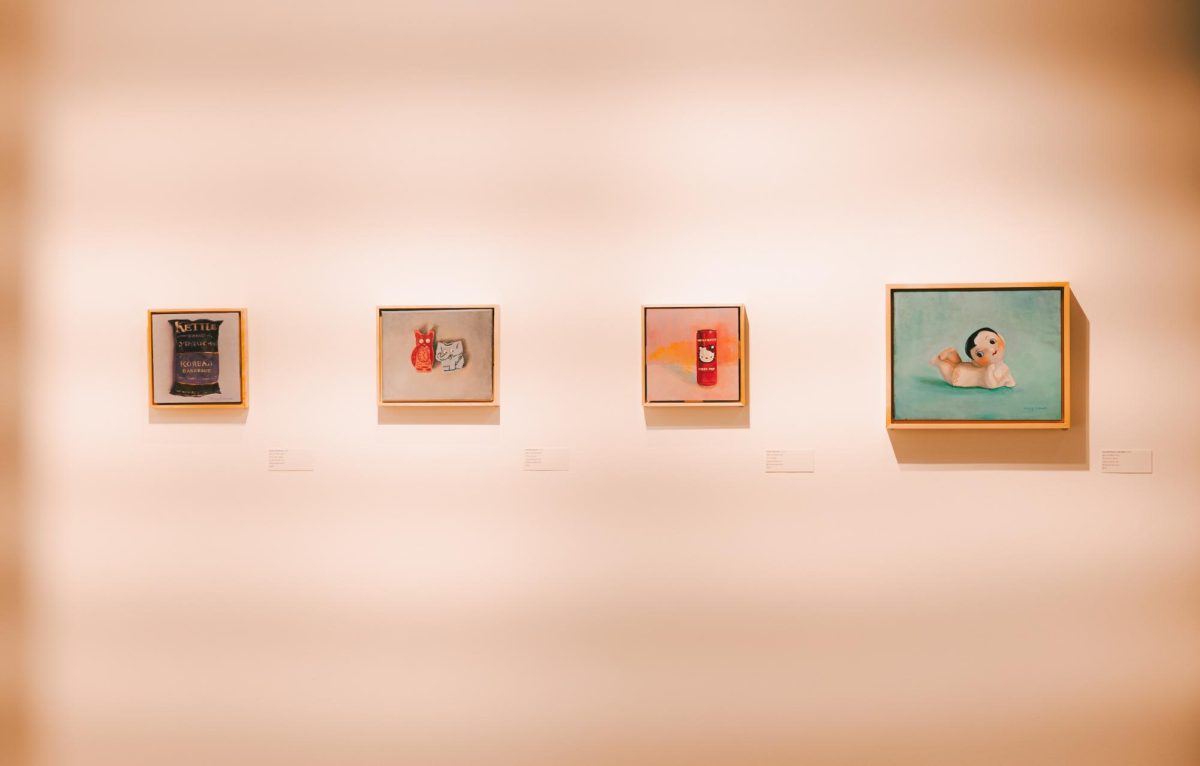


Walking into the Mixed Feelings: Existing in the Space Between exhibit at the Brea Gallery, which runs from Jan. 24 to March 20, I expected to enjoy art about identity, and “the nuances of the mixed-race experience.” What I didn’t expect, however, was leaving the carefully curated space feeling understood, seen.
The exhibit, organized by gallery director Heather Bowling, showcases work in a variety of mediums by multi-racial and multi-ethnic artists.
The open layout of the exhibit is divided by thick, white walls which guide visitors through the space, to each art piece, and the sometimes contradictory, often complex emotions the art evokes and compels.
The gallery is split into several sections, but each space remains connected by large open arches. Just as the art explores intersectionality, the gallery connects each piece seamlessly.
From brightly colored tapestries, to muted ceramics, to dark oil paintings to vibrant collages, the gallery reimagines what it means to be multicultural — exploring hybridity, intersectionality, and the emotional terrain of living between cultures. Rather than shying away from the “awkwardness” of non-belonging, the works relish in the ambiguity.
One of the greatest struggles of being mixed race — I’m half Vietnamese, half white — is the feeling of not belonging, the feeling of being too white for one group and too Asian for another. This exhibit flips this narrative of dual existences on its head; taking the uncomfortable, awkward feelings and turning them into art, into a space where belonging is natural, not forced.
“A Yi Yi,” an oil painting on canvas by Derick Edwards, hums with curiosity and possibility, centering a group of children whose different skin tones and features subtly illustrate the layered nature of identity. They crowd together in the foreground, smiling and leaning toward a bright, almost toy-like robot, as if pulled forward by the excitement of discovery. There’s a feeling that these children share something larger — community, imagination, perhaps a collective future — than any single background. Behind them, a hazy adult figure hovers like a memory or a trace of the past, suggesting the quiet presence of heritage and ancestry.
Each vivid color blends smoothly into the next, but the contrast is striking: the old symbol of culture sits quietly in the background while a new, diverse generation takes center stage. In that way, the piece is almost like a quiet statement about identity today — something fluid, collaborative, and constantly being reshaped by the people who inherit it.
“Almond Eyes,” a mix of acrylics, wood, flowers, and resin, by Eunnuri Lee, is a pair of deep brown eyes framed by a visor-shaped cut-out of a face, painted in warm, light browns. The piece stares back at us in anger? Confusion? Curiosity? Acceptance? Dried flowers and faux almonds surround each eye, highlighting the beauty of the partial face’s distinctly Asian features and irises of infinite depth.
“The Black Cousin,“ a rich oil painting by Michael Dixon portrays several white children surrounding a lone Black child. The painting exemplifies more than just existing between two cultures, but also looking like it, too. Mixed-raced children can relate to feeling different, to being singled-out, because of the way we look. But the art is a reminder that this contradiction is not a flaw to overcome, but rather a celebration of individuality.
“Korean-American or American-Korean 2,” another work by Eunnuri Lee, is a collage of digital prints from social media and historical propaganda combined with acrylics of different Asian faces and features. The collage confronts the pressure to be distinguishable, to “look” like one thing or another. Portraits often distort familiar features, obscuring the visual cues viewers often rely on to categorize race.
Each piece in the exhibit on its own tells the story of an artist, but collectively, the exhibition writes a narrative that confronts stereotypes, conformity, and identity. What makes Mixed Feelings particularly resonant is its refusal to frame fusion as either tragedy or triumph. There is no forced empowerment narrative. Instead, there’s complexity.
In an era where identity is flattened into more “palatable” versions, the exhibition insists on originality and truth. It recognizes that intersectionality is a lived experience, not some cultural divergence. And most importantly, it allows space for identities that cannot be confined to a single expectation.